

articles
How Police Intelligence Software Gives Every Call a Head Start
Nov 10, 2026
In this article
Share
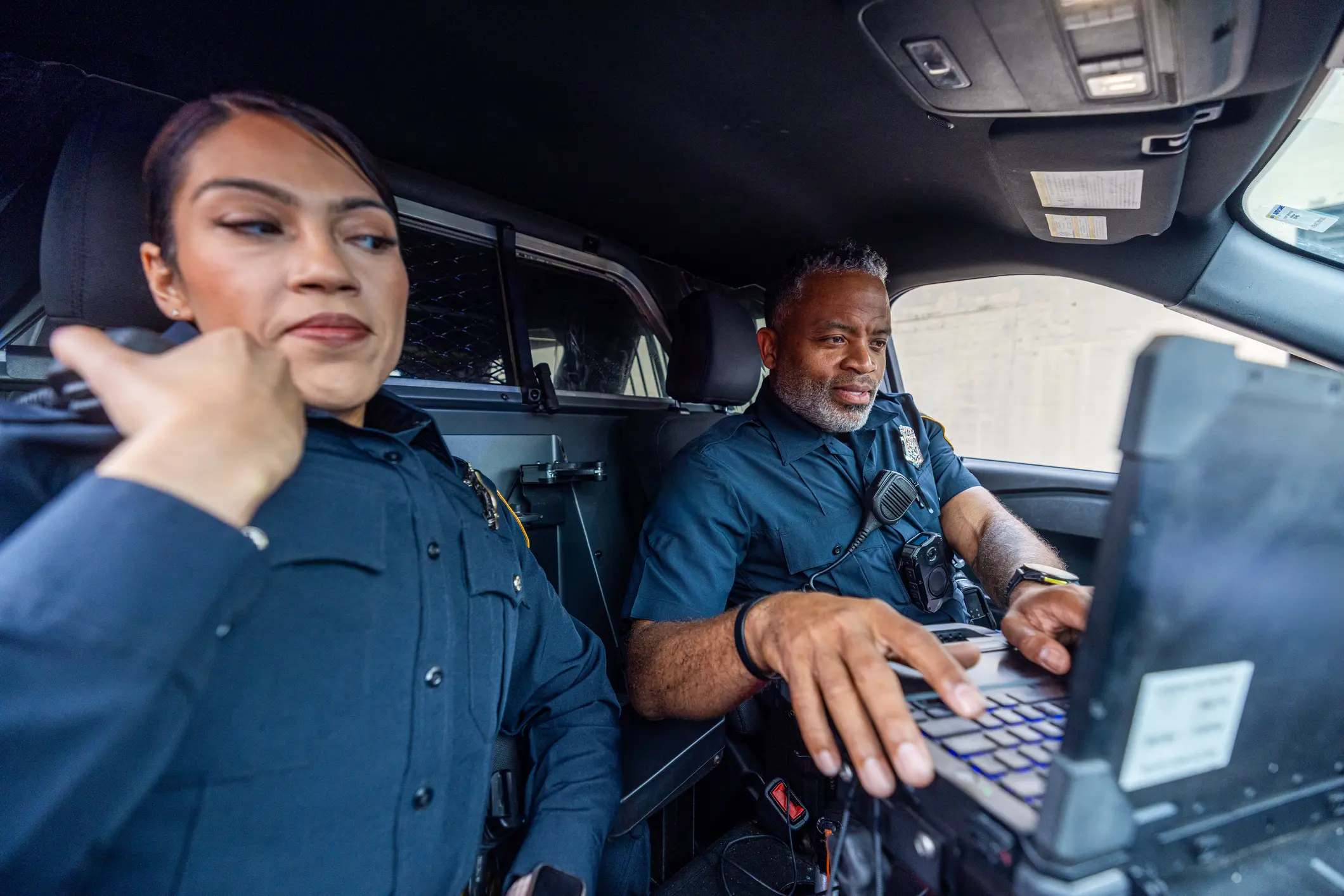
Police intelligence is the information officers, dispatchers, and investigators need for context on a call: CAD history, records, LPR hits, GIS data, and phone and property lookups.
Most agencies already have it. The problem is where it lives. Each source sits in a separate system with its own login, and stitching it together falls on dispatchers, officers, and investigators.
That work comes at a cost. According to PERF, the staffing of sworn officers has recovered to 2022 levels but is still lower than 2020 numbers. Police chiefs are leaning heavily on overtime to cover the gaps.
With fewer people handling the same call volume, officers can’t afford to wait on a manual records request every time they need context on a call. But adding staff isn’t the answer. Forward-thinking agencies are automating how intelligence reaches officers.
Why Disconnected Police Software Leaves Intelligence Stuck
Officers spend more time on paperwork than most agencies realize. According to a Police1 survey, nearly 70% spend an hour plus on documentation each shift, and more than a quarter spend two hours or more.
The main culprit is re-entering the same information into police CAD, records, body camera, booking, and LPR systems that don’t connect. Nearly a third of officers say they have little to no time for proactive work as a result.
Fragmented systems delay intelligence gathering as well. An investigator has to cross-reference records by hand across three or four systems. A dispatcher has no address history to pass along to first responders. An officer heads into a welfare check without knowing who else has been to that location.
Context matters most in a call’s first minutes. For most agencies, that’s also when it’s hardest to get.
How Police Intelligence Software Changes the Workflow
Most police intelligence software is built for analysts. Someone submits a request, an analyst pulls the relevant records, and the information eventually makes its way to the person who needed it. That workflow works for investigations with days or weeks to develop. It doesn’t work for a call that’s already in progress.
Automated police intelligence software brings the records an analyst would pull straight to dispatchers, officers, and investigators, whether or not the agency runs a real time crime center. Everyone gets the context they need as soon as a call comes in: address history, known associates, prior incidents, phone data, and maps that show how people and properties connect. No request submitted. No waiting on a callback.
Getting there requires two things. First, agencies need their data consolidated in one place rather than scattered across disparate systems. Second, they need tools simple enough that any officer can use them on the very next call, without training that takes weeks to complete.
When both are in place, officers stop waiting for intelligence and start acting on it.
Intelligence in Action: Four Agencies, Four Calls
Four agencies are already using two tools on everyday calls: FirstTwo and Centerline AI. Both tools are now built into CentralSquare One, a unified public safety platform connecting every moment of an incident. Each story below shows how agencies benefit when intelligence moves automatically.
Investigations: Great Falls Police Department, Montana
When Great Falls PD needed to quickly map a subject’s local relationships, FirstTwo surfaced cell location and social media data to identify likely contacts in the area. Centerline AI organized the raw data into a searchable format while patrol worked the case in parallel.
“Centerline helped us find what relationships she might have had locally, and we got to results much faster since we weren’t doing all that work manually.”
— Patrick Levitt, Investigator, Great Falls Police Department
Patrol: Cascade County Sheriff’s Office, Montana
On a welfare check, a deputy needed to reach someone connected to a property but had no direct contact. FirstTwo identified names and phone numbers tied to the address. A reverse phone lookup and an NCIC photo confirmed the suspect’s identity without a single manual records request. The deputy had what they needed before arriving on scene.
Response: Livingston County Sheriff’s Office, Michigan
A caller couldn’t provide an address when reporting a structure fire. FirstTwo mapped the location from available data, and dispatch used it to pull a contact number and call the homeowner before the fire department arrived.
“For a structure fire at an address we didn’t have much information on, FirstTwo let us pull the number and start calling to reach the homeowner before the fire department even got there.”
— Lieutenant Chad Sell, Livingston County Sheriff’s Office
Adoption: Allen Police Department, Texas
Adoption is often the hardest part of deploying new technology, but that wasn’t the case at Allen PD. Staff found Centerline AI’s CJIS-compliant chatbot on their own within minutes. Centerline AI is designed to save officers and staff 40 or more hours a month on paperwork and case review. Ultimately, that time goes back to higher-priority work.
What’s Next for Law Enforcement Intelligence Analysis
Law enforcement has access to more data than ever before, but most agencies can’t fully utilize it. The next wave of public safety technology will layer existing data to surface answers faster.
Take the phone ping as an example. A missing person’s phone ping can land anywhere from a few dozen to more than 300 meters from their actual location, depending on the carrier. That’s a wide radius, but it narrows fast when you can cross-reference nearby residents against known associates in real time.
“If you’re standing there with the family for a runaway or a missing person, you could ask right away whether they recognize a nearby last name, and that alone could clear out a lot of ground fast.”
— Lieutenant Chad Sell, Livingston County Sheriff’s Office
The next generation of intelligence tools, like CentralSquare One, will close the gap between the data agencies have and the speed at which officers can use it.
CentralSquare One: Police Intelligence Built Into Public Safety Software
CentralSquare One is the unified intelligence layer built into CentralSquare’s Public Safety suites. Today it connects police CAD, Centerline AI, and FirstTwo, so intel reaches dispatchers as soon as a call comes in.
The intel from the stories above didn’t require a separate request or a manual search. It surfaced automatically when a call came in or a number went into a report.
With CentralSquare One, dispatchers, officers, and investigators get what they need without leaving the system they’re already in. As Detective Jacob Svoboda of Madison County Sheriff’s Office put it, “No toggling between different data sources like LPR, GIS, or department records.”
The goal is a single platform with automatic intel, where officers work more efficiently and safety improves – without adding more tools to learn or logins to manage.
Next Steps for Your Agency
The best place to start is with your most common calls. It could be a welfare check, an unknown address, or an unnamed phone number. Count how many systems and logins it takes to get the intel you need for that call.
If the answer is more than one, there’s room to improve.
CentralSquare One is built for agencies that are ready to close the intelligence gap. To see how other agencies are already using FirstTwo and Centerline AI on everyday calls, download the CentralSquare One customer stories guide.
Download the CentralSquare One Customer Stories Guide
Frequently Asked Questions
What is police intelligence software?
Police intelligence software gives dispatchers, officers, and investigators context on a call from data an agency already holds, including CAD history, records, LPR hits, GIS data, and phone and property lookups. The most useful tools deliver that context automatically when a call comes in, so no one submits a request or logs into a second system.
How is police intelligence software different from a real time crime center?
A real time crime center relies on analysts who receive requests, pull records, and pass findings to the field. Police intelligence software delivers address history, known associates, prior incidents, and phone data automatically to the people working the call. The two can work together, with the software handling routine context so analysts can focus on complex cases.
What is the best police intelligence software for small agencies?
The best fit for a small agency consolidates data in one place and is simple enough for any officer to use on the next call, without weeks of training. Fewer logins matter most when staffing is tight. To compare options, count how many systems it takes to get context on your most common calls, such as a welfare check or an unknown address.
What does CentralSquare One connect?
CentralSquare One is the unified intelligence layer built into CentralSquare’s Public Safety Suites. Today it connects police CAD, Centerline AI, and FirstTwo, so dispatchers, officers, and investigators get intelligence as soon as a call comes in without leaving the system they’re already in.

This website uses cookies to ensure you get the best experience on our website. By continuing on our website, you expressly consent to our use of cookies, Privacy Policy and Terms of Use. To find out more about how we use cookies, please see our Privacy Policy.